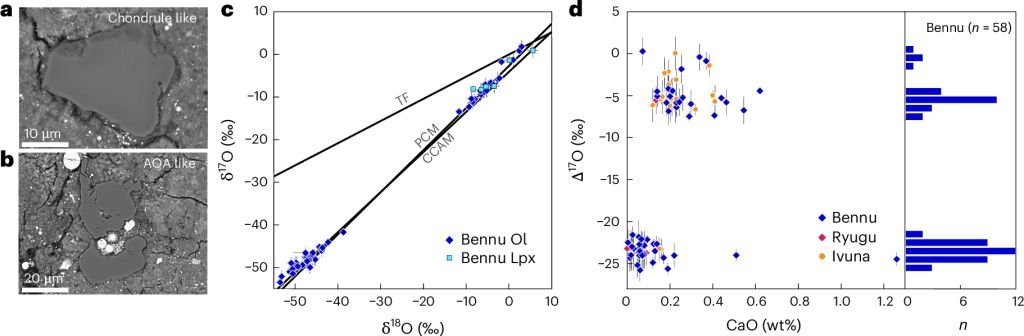
The first results obtained by the OSIRIS-REx SEIWG team lead by Jess Barnes and Anh Nguyen are now published in Nature Astronomy. The paper includes SIMS measurements of the oxygen isotopes we have obtained on our instruments at CRPG. Check it out !
Barnes, J.J., Nguyen, A.N., Abernethy, F.A.J., Bajo, K., Bekaert, D. V, Bloch, E., Brennecka, G.A., Busemann, H., Cowpe, J.S., Crowther, S.A., Ek, M., Fawcett, L.J., Fehr, M.A., Franchi, I.A., Füri, E., Gilmour, J.D., Grady, M.M., Greenwood, R.C., Haenecour, P., Kawasaki, N., Koefoed, P., Krietsch, D., Le, L., Liszewska, K.M., Maden, C., Malley, J., Marrocchi, Y., Marty, B., Meyer, L.A.E., Peretyazhko, T.S., Piani, L., Render, J., Russell, S.S., Rüfenacht, M., Sakamoto, N., Schönbächler, M., Shollenberger, Q.R., Smith, L., Thomas-Keprta, K., Verchovsky, A.B., Villeneuve, J., Wang, K., Welten, K.C., Wimpenny, J., Worsham, E.A., Yurimoto, H., Zimmermann, L., Zhao, X., Alexander, C.M.O., Amini, M., Baczynski, A., Bland, P., Borg, L.E., Burgess, R., Caffee, M.W., Chaves, L.C., Clay, P.L., Dworkin, J.P., Foustoukos, D.I., Glavin, D.P., Hamilton, V.E., Hill, D., House, C.H., Huss, G.R., Ireland, T., Jilly, C.E., Jourdan, F., Keller, L.P., Kruijer, T.S., Lai, V., McCoy, T.J., Nagashima, K., Nishiizumi, K., Ogliore, R., Ong, I.J., Reddy, S.M., Rickard, W.D.A., Sandford, S., Saxey, D.W., Timms, N., Weis, D., Wilbur, Z.E., Zega, T.J., DellaGiustina, D.N., Wolner, C.W. V, Connolly, H.C., Lauretta, D.S., 2025. The variety and origin of materials accreted by Bennu’s parent asteroid. Nat Astron. https://doi.org/10.1038/s41550-025-02631-6
Abstract
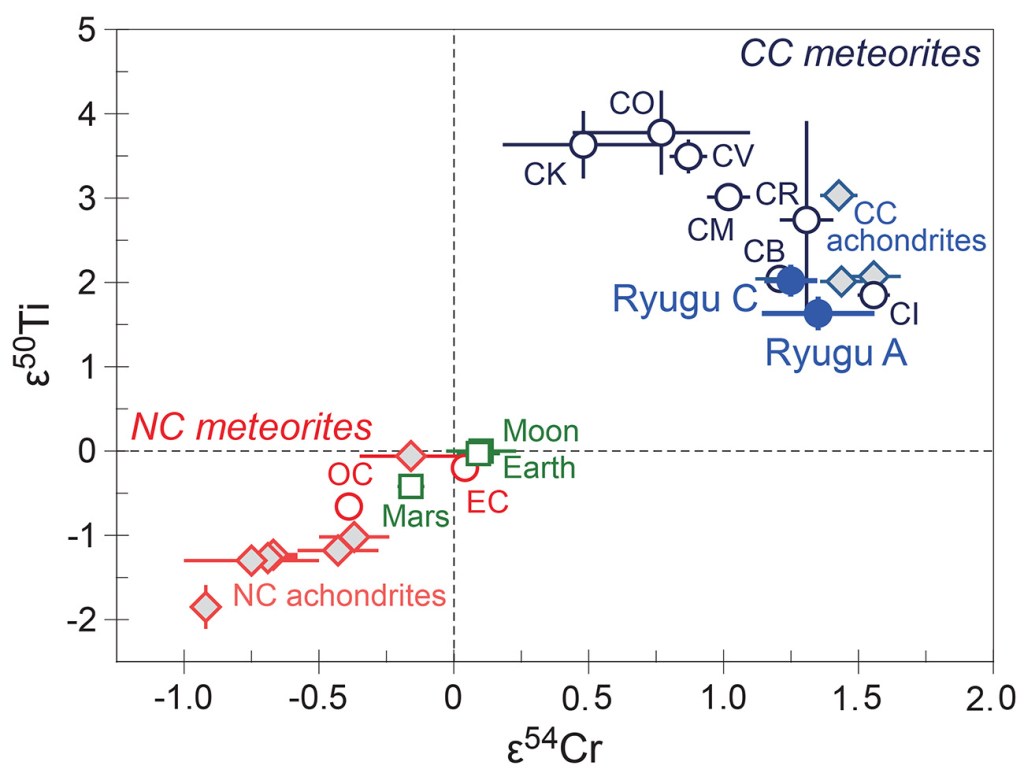
The first bodies to form in the Solar System acquired their materials from stars, the presolar molecular cloud and the protoplanetary disk. Asteroids that have not undergone planetary differentiation retain evidence of these primary accreted materials. However, geologic processes such as hydrothermal alteration can dramatically change their bulk mineralogy, isotopic compositions and chemistry. Here we analyse the elemental and isotopic compositions of samples from asteroid Bennu to uncover the sources and types of material accreted by its parent body. We show that some primary accreted materials escaped the extensive aqueous alteration that occurred on the parent asteroid, including presolar grains from ancient stars, organic matter from the outer Solar System or molecular cloud, refractory solids that formed close to the Sun, and dust enriched in neutron-rich Ti isotopes. We find Bennu to be richer in isotopically anomalous organic matter, anhydrous silicates, and light isotopes of K and Zn than its closest compositional counterparts, asteroid Ryugu and Ivuna-type (CI) carbonaceous chondrite meteorites. We propose that the parent bodies of Bennu, Ryugu and CI chondrites formed from a common but spatially and/or temporally heterogeneous reservoir of materials in the outer protoplanetary disk.


 Laurette Piani